

Introduced: 2026
These finely detailed and smooth running models are available either with or without DCC-Sound (the so called "Stealth" versions are simply DCC Ready and have no decoder or speaker). The sound versions (at least on the initial 2026 release) feature a factory-installed Paragon4 DCC Sound decoder and speaker. And like the rest of BLI's steam locomotives of similar vintage, these DCC Sound models come with working smoke units and are designed to run equally well on analog or DCC layouts (although analog users will need one of BLI's "DC Master" control boxes in order to take advantage of all the sound and smoke features). Support is also provided for BLI's "Rolling Thunder" external sound system.
Designed along the same lines as BLI's 2023 Mallet models, the Challenger's shell is metal and divided into two halves (with the lower half serving as an ersatz chassis for the moving parts). The motor is a closed-sided can, which probably means that it's coreless. Each motorshaft is equipped with a decent sized flywheel. Plastic "notched cup" u-joints on the ends of the motorshafts spin "spiked donut" connectors on the wormshafts. The brass worms live inside of lidded plastic boxes on top of the engines. Arched extensions off of the tops of the worm boxes hold the engines inside the chassis (and with both engines being fully articulated).
Six wires from the motherboard transfer current to the motor, the headlight, and to the smoke unit. The headlight is white and very bright. Eight wires (for track power, motor control, lighting control and smoke control) run from the motherboard, through the drawbar, and ultimately to the decoder (or Stealth board) in the tender. Said wires are fixed inside of a plug that connects to a socket on the decoder board. So, to completely separate the tender and the locomotive you would need to remove the tender shell and pull out the wiring plug.
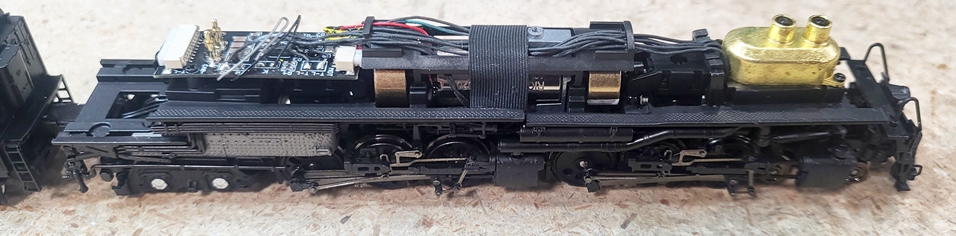
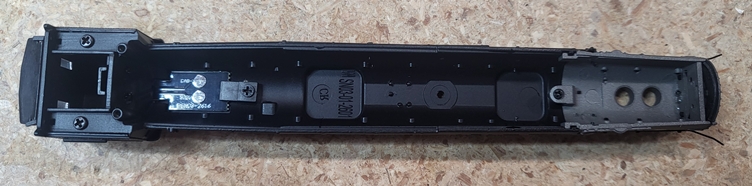
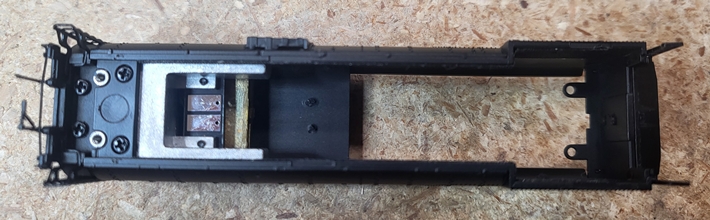
Copper posts on the back of the motherboard transfer current to contacts inside the shell for the cab interior lighting.
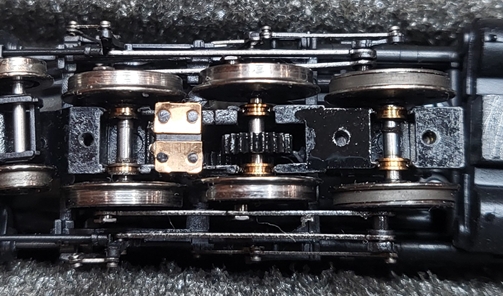
Eight of the twelve drivers provide pickup (the rear driverset on each engine is electrically neutral, as are the pilot and trailing trucks). The rear driverset on the forward engine is equipped with traction tires. Current flows from the drivers, to the axles, and then ultimately to the engines by way of round brass bushings that seat inside cutouts in the engine frame. Each engine has a "live" section that is somehow insulated from the rest of the engine. Wires soldered to copper contacts on this live section conduct current to the motherboard. Only one axle per engine is geared (the center one), and with the rest of the driversets being turned solely by the running gear. Apart from the brass worms, all gearing is plastic. The gears are all lubricated from the factory (and rather heavily lubricated at that).
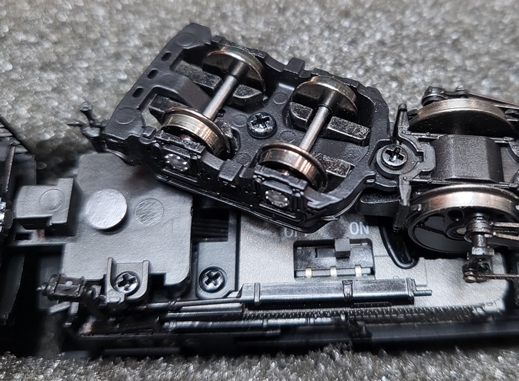
An on/off switch underneath the trailing truck is provided for the smoke generator. If the switch is in the "on" position, F7 will turn the smoke on and off. The generator is completely disabled if the switch is in the "off" position. Note that the "state" of F7 (on or off) doesn't matter, pushing the button does. The smoke generator runs on a timer, and hitting F7 starts and stops that timer. IE, if the timer isn't ticking, F7 starts it. And if it is ticking, F7 stops it. Not exactly intuitive, but there you go. CV218 controls how long the timer runs, with each increment representing 2 seconds of smoke. The default setting is thirty (IE sixty seconds of smoke). BLI recommends using a lightweight smoke fluid such as Marklin or JT Mega Steam. 10 drops into the smokestack using the included pipette will produce around four minutes worth of smoke.
The pilot is equipped with a one-piece knuckle coupler. As delivered, the coupler is hidden behind the pilot and can be swung into place like a revolving door. And I guess it's just there for looks because it doesn't appear to be operational in any sort of practical sense. A plastic stud holds the front of the drawbar to the locomotive chassis. The rear of the drawbar is basically held in place by the wires (aided by a small protrusion off the bottom of the drawbar that keeps it from pulling out too far). The wheels are blackened and low-profile (IE no problems on Atlas Code-55 rails). A small baggie in the box contains a spare traction tire. It also includes a second tender deck option (different from the one installed on the model).

The tender chassis is metal, whereas the shell is plastic. The coupler is chassis-mounted and designed along the lines of an MTL.
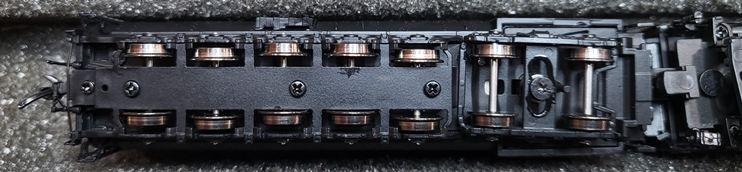
Only five of the fourteen tender wheels provide pickup (two on the left and three on the right). Sadly, axle wipers are used to collect track current inside the centipede "truck" (an archaic design that should've been retired fifty years ago). The non-live wheels have insulator rings around the axle ends to prevent short circuits (IE, don't get them installed backwards if you ever have the need to remove them).
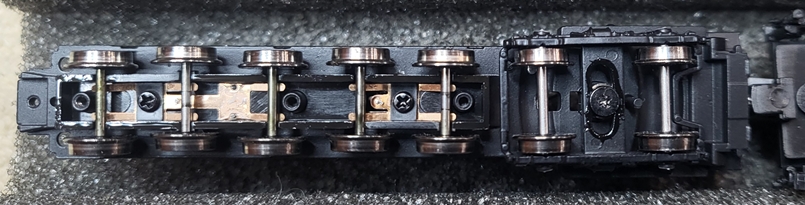
Wires soldered to the axle wipers transfer current to a motherboard screwed to the back of chassis. Additional wires transfer current from the motherboard to the Paragon4 decoder. I'm told that the Stealth motherboard comes equipped with a Next18 DCC interface.
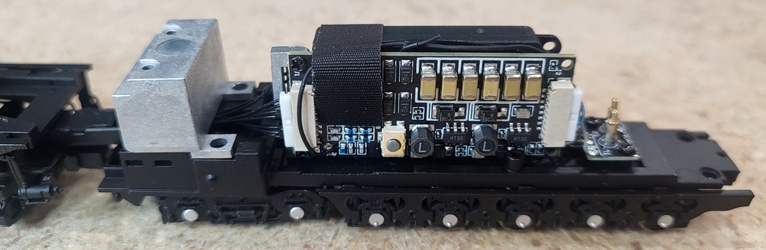
Two copper posts on the motherboard transfer current to the backup light inside the tender shell.
Note that the behavior for the headlight and sound is a little strange (as least as compared to what we're used to from other manufacturers). When the locomotive is first put on the rails there is no sound and no headlight (regardless of whether F0 is selected or not). The sound comes on once the locomotive starts moving (and stays on until either you mute it with F8 or recycle track power). As for the headlight, that doesn't come on until about three seconds after the locomotive has started moving (and then, like the sound, stays on until you either deselect F0 or recycle track power). The headlight is directional insofar as it will get brighter when moving forward and turn off when moving backward.
Be it in analog or DCC mode, these are impressive runners in all respects. Right out of the box, mine performed flawlessly (no preemptive wheel cleaning or lengthy break-in period required). It ran smoothly and whisper quiet at all normal operating speeds. Slow speed creep (at speed step 1) is impressive, although not quite one-tie-at-a-time. The top-end speed is reasonable and realistic. Pulling power is off the charts (50+ cars through curves on level track). Pickup is superb, with mine able to creep through non-powered frog turnouts without so much as a stutter. I didn't have any problems with any of the wheels derailing (even on 9.75"-radius curves). The couplers function quite well (they readily auto-couple and don't spontaneously come uncoupled). The sound and smoke features work just fine and are loads of fun. Overall, these are outstanding looking models that run every bit as good as good as they look.
Prototype -
Between 1936 and 1944, the American Locomotive Company (ALCO) constructed a total of 105 Challengers in five classes for the Union Pacific. These locomotives were approximately 122 ft (37 m) long and weighed 537 short tons (487 tonnes). While primarily used for freight service across the Union Pacific system, a few were also assigned to passenger trains like the Portland Rose. The design and operational experience of the Challengers played a crucial role in shaping the renowned Big Boy locomotive type, which, in turn, influenced the design of the last three orders of Challengers. The Challengers boasted several technical breakthroughs that contributed to their success. Operating with a high boiler pressure of 280 lbf/in2, a feature typically reserved for passenger locomotives such as the FEF Series, they sported 69-inch drivers—impressive mammoth wheels typically found on passenger locomotives. Most freight engines required smaller wheels to generate the necessary torque. Surpassing speeds of 60 miles per hour, which was unprecedented for most other railroads using articulated steam locomotives, became a regular occurrence on the Union Pacific.
During Union Pacific's fourth order in 1943, ALCO built thirty-one locomotives adhering to the same specifications. However, due to the War Production Board's intervention, six completed locomotives were diverted to the Denver and Rio Grande Western Railroad through a lease facilitated by the War Department's Defense Plant Corporation. These locomotives, numbered 3900-3905, formed the Rio Grande's Class L-97. Later, in 1947, they were sold to the Clinchfield Railroad and renumbered as 670–675, becoming the Clinchfield's Class E-3. Unfortunately, these six Challengers were eventually retired in 1953. Among the surviving Challengers, Union Pacific No. 3985 stands out. Restored by the Union Pacific in 1981, it operated in excursion service as part of the heritage fleet program. Recently, it was donated to the Railroading Heritage of Midwest America organization in 2022, where it is currently undergoing a second restoration. The only other surviving Challenger, UP No. 3977, is on display in North Platte, Nebraska.
Locomotive Features -
- Paragon4 Sound & Control System featuring ROLLING THUNDER
- Integral Dual-Mode Decoder with Back EMF for Superb Slow Speed Operation in DC and DCC
- Precision Drive Mechanism Engineered for Heavy Towing and Smooth Slow Speed Operation
- Operating Smoke Unit with On/Off Switch - Note that N scale smoke units require a thin-viscosity smoke fluid such as JT's Mega Steam or Marklin's #02421 smoke fluid
- Die Cast Locomotive Body with Die Cast Chassis for Heavier Weight and Maximum Tractive Effort
- Rubber Tires on Two Drivers for Additional Tractive Effort
- Premium Caliber Painting
- Prototypically Accurate Paint Schemes and Road Numbers
- Many Separately Applied Details such as Handrails, Grab Irons, Piping, Tender Ladders, Whistle, and Bell
- Accurate front end modeling, including an appropriate aftercooler system for each class
- Accurate modeling of the 25-C-100 and 25-C-400 tenders, tailored to match each class
- An accurately modeled oil tender specific to No. 3985, representing its excursion service
- Prototypical Headlight and Rear Light Operation
- Separately Controllable Cab Light
- Prototypically Accurate Sounds for the Union Pacific Challenger
- Operating Microtrains-compatible Couplers
- Will Operate on Code 55, Code 70, and Code 80 Rail
- Minimum Operating Radius: 9.75 inches
DCC/Sound Features -
- Operates in DC & DCC with improved DC speed control (use DCMaster for DC Sound)
- Built-In extra capacitance to navigate imperfect track
- Pro Lighting Mode offers individual control of all lights on model
- Switcher Mode for precise low speed control
- Record & Play Operation - Records and plays back sounds and movements once or repeatedly for automatic operation
- High Resolution Audio
- Quillable Horn for various whistle lengths and patterns
- Choice of 3 selectable Horns
- Alternate Whistle / Horn where applicable for locomotive with air horn and steam whistle - both the main whistle and alternate can be easily played
- Adjustable bell ringing interval for faster or slower bell
- Numerous user-mappable functions with available keys
- Multiple realistic passenger and crew sounds play on command
- Grade Crossing Automatic Signal
- Automatic Forward / Reverse Signal
- Prime Mover sound intensity varies with load
- Individually adjustable sound volumes for each effect
- EZ Reset Button for quick return to factory default settings
Shell Removal -
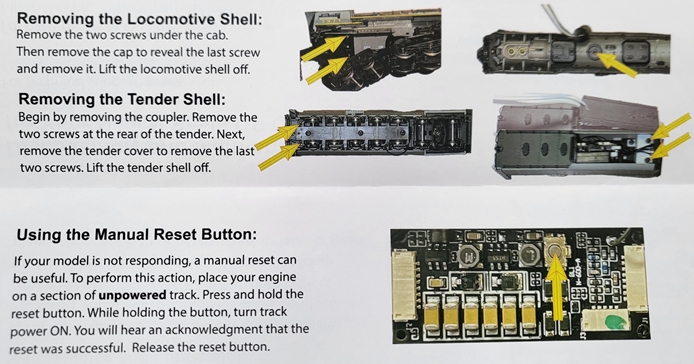
So, here's something that you rarely see. BLI included actual pictorial shell removal instructions right in the box along with the rest of the documentation (a major nicety for which they should receive some sort of medal of honor) -
Grade: A