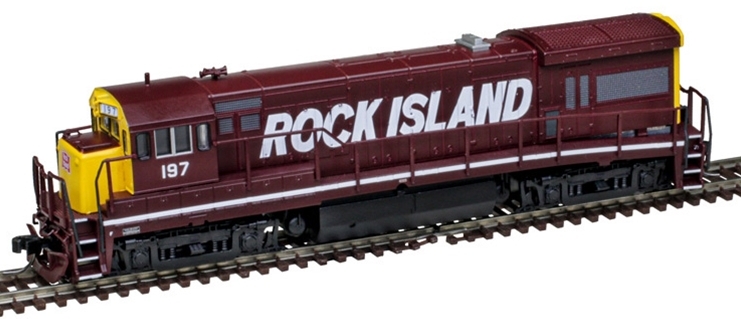
Introduced: 2025
These models are available either DCC-Ready or with a factory-installed ESU LokSound decoder. Note that there are no external differences between GE's U33B and U36B diesels, and hence the dual naming convention "U33/U36B" employed by Atlas. Atlas's models are available in both early and late phases. The early phase model includes flush-mounted radiator and air intake screens on the long hood. In addition, there is a built-out area on the top of the front and rear pilots. Late phase models feature corrugated radiator and air intake screens and a flat pilot face.
These models employ the same chassis/mechanism used by Atlas in their redesigned U23B release of 2024. The chassis is essentially one big hunk of metal with wires from the trucks transferring current directly to the motherboard. Additional wires from the motherboard transfer current to the motor contacts. Each wiring pair has a plug that connects the wires to the motherboard. LEDs mounted to either end of the board provide directional lighting. The drivetrain components drop inside of the chassis and a separate metal lid screwed to the top holds everything in place. The motherboard is screwed to the top of the chassis lid. The motherboard comes with a preinstalled speaker on all models. The DCC interface (designed by ESU) is designated as "E24". The open-sided motor is five-pole and skew-wound. Each motorshaft is equipped with a large brass flywheel.
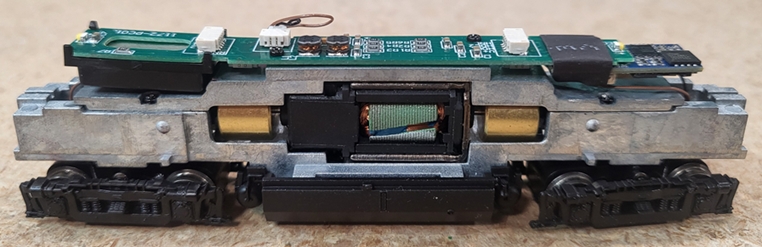
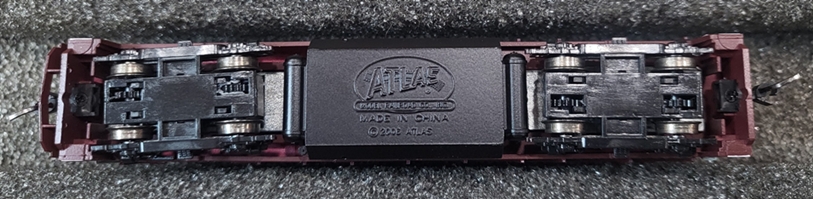
All four axles are geared and all gearing (apart from the worms) is black plastic. Dimpled axle wipers collect current from each of the eight wheels. Wheels are blackened and low profile (no problems on Code 55 rails). There are no traction tires. Wires soldered to the tops of the axle wipers transfer current to the motherboard. The Accumate couplers are shell mounted.
Performance on these models is outstanding in every way. Mine ran great right out of the box, so no pre-emptive wheel cleaning required. Performance is super smooth and whisper quiet at all throttle levels. Slow speed creep is one-tie-at-a-time and the top-end speed is reasonable and realistic. No problems on sharp (9.75" radius) curves. Pulling power is off the charts, with mine comfortably able to handle 50+ assorted 40' freight cars through curves on level track. The sound is realistic and nicely rendered. Overall, one of the more outstanding locomotive releases from Atlas in recent memory.
Prototype information -
The horsepower race was in full swing by the late 1960s when GE introduced the 3,300hp, four-axle U33B locomotive. 137 units were produced between September 1967 and August 1970 when production ended. GE upped the horsepower ante in 1970 with the introduction of the 3,600hp U36B which was produced between May 1970 and December 1974. Both models were externally identical, and internally they were both powered by the same GE FDL-16 cylinder four-stroke engine. The horsepower increase was achieved through adjustments to the fuel rack settings and other internal component changes. One key spotting feature of both models was the built-out radiator "wings" on the long hood.
Model Features -
- All New Tooling
- Factory-installed AccuMate magnetic knuckle couplers
- Blackened metal wheels
- Scale Speed motor
- Accurate painting and lettering
- Optional separate electrical equipment box will be included on the left side walkway behind the cab per the prototype
- AAR-B or Blomberg trucks will be used where appropriate
- Equipped with EC24 DCC Socket
- Atlas Master Silver version is DCC-Sound ready and equipped with a speaker for easy conversion
DCC Features (Gold version) -
- Supports all DCC-programming modes
- Includes RailCom and RailComPlus, with 14, 28 or 128 speed steps and with 2-digit and 4-digit addressing
- Flexible mapping of function keys F0 to F28
- A total of 6 DCC function outputs are available, and all can be function mapped (disable, brightness, light effects) individually
- Follows all NMRA DCC standards and recommended practices
- Over 20 sound effects are available, including engine start-up and shutdown, prime mover sounds through all eight notches, bell, air horn, air compressor, dynamic brakes and more
- Up to 16 user-selectable horns, 2 user-selectable bells, and 2 user-selectable synchronized brake squeals
- Equipped with ESU's Exclusive "Full Throttle" features for ultimate realism in prototype running
Shell removal -
Four small bumps in the chassis insert into shallow dimples inside the shell and it's possible to remove the shell simply by taking hold of the fuel tank with one hand and the shell with the other and then wiggling the shell up and off. Of course, inserting some toothpicks or similar between the shell and chassis will help things along and make the procedure a little easier.
Grade: A