

Introduced: 2002 (Life-Like Canada version), 2003 (Life-Like version) and 2026 (Atlas version)
As noted above, the initial 2002 release of these models was produced by "Life-Like Canada". This release was limited to 180 units produced in each of five different Canadian paint schemes. In 2003, a more widespread release was issed by "normal" Life-Like. Atlas acquired the tooling for Life-Like's C-424 (among other models) in 2018 and released revised versions starting in 2026.
The Life-Like mechanism sports most of the features one normally associates with "modern" diesel models - IE, split-frame / all-metal chassis, five-pole / skew-wound "scale speed" motor with dual flywheels, low-friction drive, bi-directional LED lighting, all-wheel drive and pickup (no traction tires), blackened / low-profile wheels, shell-mounted couplers (Rapidos, though), all-plastic gearing, etc. Unfortunately, there is no support for DCC whatsoever (kind of disappointing for a model released in 2002).

Performance on these early models is perfect in every way - smooth, quiet, flawless pickup and throttle response, great pulling power, etc. Oddly enough though, this model will not run without its shell. With the motor free to move around, it will spin itself out of contact with the chassis and lose power. Bizarre!
The main problem with this model is that it just plain looks weird (what with the locomotive chassis being clearly visible beneath the shell). Now, I'm told by those that know that this was an actual feature of the prototype. However, real C-424's also have framerails which conceal said large gap between the carbody and the trucks (a feature that this model sorely lacks).
As noted above, Atlas released their own version of the C-424 in 2026. These models have completely redesigned internals and provide support for DCC sound (basically following the same design as the SD45 models Atlas released in 2024).

The chassis consists of a metal base with a metal bracket screwed to the top (holding the motor and drivetrain in place). The motor is an open-sided 5-poler with skew-winding. Each motorshaft is equipped with a flywheel. Plastic driveshafts seat inside of the flywheels and connect to notched cups on the truck towers. Short metal shafts connect the cups to the brass worm gears mounted inside the truck towers.
The motherboard is screwed to the top bracket and receives current from the trucks by way of four wires. Separately wired boards (one at the back and one in the cab) provide bright white LED lighting for the headlight and backup light. Additional LEDs on the motherboard provide light for the front and rear number boards as well as the cab interior. The headlight and backup light are directional whereas the number board and cab lighting is not. Note that F24 controls the cab interior and number board lights while F27 controls the rear number board lights (a fact that the included list of functions does not mention). Additional wires run from the motherboard to the motor and to a speaker mounted inside the fuel tank. The decoder interface on the motherboard is "Next18" (aka NEM662).
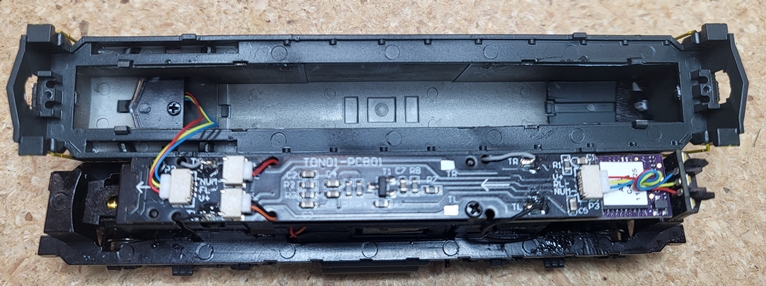
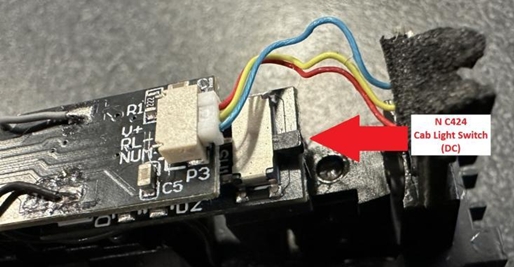
Analog users should note that there is a switch on the motherboard that supposedly turns the cab light on and off (a mystery feature that, once again, is not mentioned in any of the documentation).
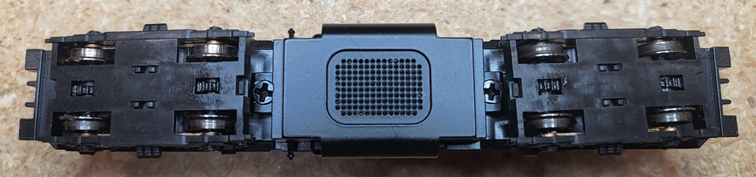
All four axles are geared and all gearing (apart from the worms) is plastic. The wheels are blackened and low-profile (no problems on Atlas Code-55 track). There are no traction tires. Micro-Trains automatic couplers screw in between the chassis and the shell. The fuel tank is screwed to the bottom of the chassis and holds the speaker.
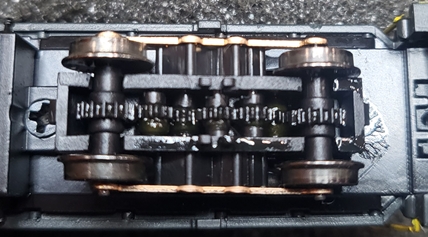
All 8 wheels provide pickup by way of axle-end wipers (the axle ends seat inside of holes in said wipers). Wires soldered to the axle wipers transfer current to the motherboard. The trucks are a rather complex assembly and removing them would likely be a somewhat daunting proposition. An extension on the top of the plastic truck tower assembly holds the trucks inside the chassis, and so I guess you would basically have to completely disassemble the truck towers and disconnect the driveshafts in order to get the trucks off. As pictured below, the truck gears come rather heavily lubricated from the factory -
Sadly, the elephant in the room (the large gap between the shell and the trucks) was not addressed. Also, I haven't tried it myself, but I'm told by others that putting an old (Life-Like) shell on this new chassis is not a straight up swap (IE, grinding and other heroic measures are required).

Basic performance on these Atlas models is excellent right out of the box - smooth, whisper quiet, no stalls or stuttering, great slow-speed creep and a realistic top-end speed. I didn't have any problems with the wheels derailing (even on 9.75" radius curves). On the downside, the sound feature is (at least to my ear) a bit underwhelming. Even at max volume it can get drowned out by the movement of the train itself if you try to run it at or above 50% throttle. I would recommend putting some tape over the "dumb idea" holes in the fuel tank as this does seem to be improve the sound quality. Lastly, pulling power isn't particularly impressive, with mine only able to handle around 20 assorted 40' freight cars through curves on level track (which is, for me, about the bare allowable minimum for a diesel of this size).
One minor annoyance I have with the SoundTraxx decoder is the whole protracted "start up" sequence the locomotive goes through when starting from a dead stop (basically the locomotive sits there making various noises for 4-5 seconds before it starts moving). All very prototypical I'm sure, but not something I really want to have to deal with (particularly when MU'ing with some other type of loco that just wants to go). Changing CV114 from 23 to 39 enables "engine interlock" and eliminates the startup delay.
Trivia - Back in 2012, an outfit called "Briggs Models" sold a C-425 resin shell kit designed to fit the Life-Like mechanism (not sure if they still do) -

Shell removal -
Life-Like version - take hold of the fuel tank with one hand and the shell with the other and then just sort of wiggle the shell up and off.
Atlas version - remove the couplers and the shell will lift right up and off.
Grade: B (for either version)
Reviewed: 08/04 Model Railroader ("A good looking Alco C-424 with a smooth-running mechanism is a recent release from Life-Like. It neatly captures the clean lines and chunky look of the prototype. Life-Like's N scale C-424 features a well-detailed plastic shell and includes thin-profile acetal plastic handrails, separately applied air horn, and flush-fitting side windows with silver-painted frames. The model has the protruding rear number boards of a Phase I... The body shell has an extra scale 18" in the hood behind the cab, and the truck wheelbases are 4" too long... It's carbody appears to sit too high above the tracks, although the overall height is correct... The model runs well as it's fitted with a typical split-frame chassis... pulls 19 cars... The C-424 has no provision for DCC... The locomotive comes with body-mounted Rapido-style couplers... Our sample came neatly decorated... The model's dimensional flaws aren't obvious, so Life-Like's C-424 is a nice model that fills an important gap in the N scale Alco roster. BN, CNW, Conrail, EL, NYNHH, PC, PRR, SPS, Undec. $80")