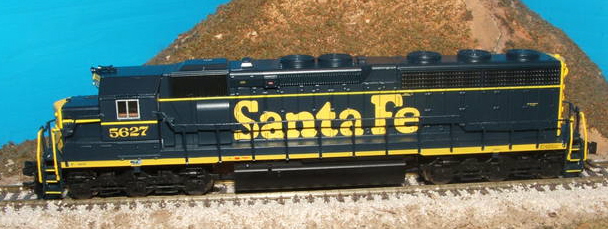
Introduced: 2008 (DCC-Ready version) and 2026 (DCC-Sound version)
Mechanically, the original production run of IMRC's SD45-2 employed a design very much in keeping with the conventions employed by Atlas in their diesels of similar vintage. In fact, Intermountain and Atlas diesels appear to actually share many of the same internal components (motor, etc). Just speculating here, but I assume this means that they were made at the same Chinese factory that Atlas used.
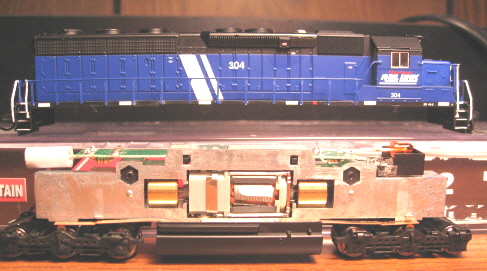
The first run mechanism sports all the features one normally associates with "modern" diesel models - IE, DCC-Ready / split-frame / all-metal chassis, 5-pole / skew-wound / "slow speed" motor, dual flywheels, low-friction drive, bi-directional LED lighting, all-wheel drive and pickup (no traction tires), blackened / low-profile wheels, shell-mounted Accumate couplers, all-plastic gearing, etc.
Performance-wise, this locomotive is perfect. Smooth, quiet, responsive and powerful. Excellent slow speed creep and reasonable top-end. On the downside, I find the paint to be a bit heavy looking in spots. Nothing horribly noticeable, but definitely not as sharp and fine as an Atlas or Kato. Like other Intermountain diesels, all of the various shell pieces are glued together. So disassembly (for painting purposes) is not as easy it could/should be. Fortunately, they don't appear to be as flimsy and prone to falling apart as the earlier Intermountain "Tunnel Motor" models. Decoder installation is fairly simple, and the procedure is exactly the same as installing a decoder in an Atlas diesel (IE, you have to de-screw the two halves of the frame in order to install the decoder). Overall, these are fine looking and great running models.
Having said all that, I'm told that there are indeed a few "rivet counting" type issues to worry about (for those that worry about such things).
- No gap between the dustbin hatch and exhaust hatch
- No beads on the blower ducts
- Incorrect fuel tank (first run only - fixed on subsequent runs)
- Incorrect sill cutout (too short)
- Various profile height inaccuraciess on the EL/CR version (the dustbin hatch, exhaust hatch, dynamic fans, engineroom vent and radiator fans
are all supposed to be low-profile - and they're not)
As noted above, DCC-Sound versions of the SD45-2 were released starting 2026. These employ the same chassis/mechanism used in IMRC's SD40-2 and come with an ESU LokSound decoder. DCC Ready models were also part of this release (and presumably come with the same speaker used on the sound-equipped models). Internally, these models are quite a departure from the previous version. Being screwless and wireless, the fuel tank, motor saddle, and two plastic clips (one on the nose and one underneath the rear end of the PCB or decoder) serve to hold the whole assembly together -
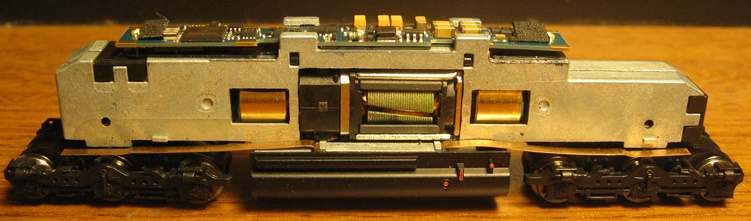
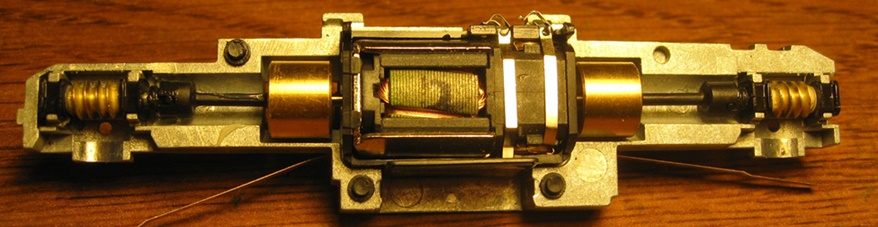
The chassis is all-metal and split-frame. The "slow speed" motor is 5-pole and skew-wound. Each motorshaft is equipped with a brass flywheel. The plastic driveshafts have hex ends that plug into the flywheels. The other ends have notched cups that click onto ball-and-pin connectors on the wormshafts. The worms seat inside of bearing blocks that are slotted into notches in the chassis -
Metal contacts for motor and speaker current are part of the plastic motor saddle assembly (lined up with metal contact pads on the PCB or decoder). A long plastic shield is clipped to the top of the chassis (dunno why - maybe to prevent short circuits between the decoder and chassis?)
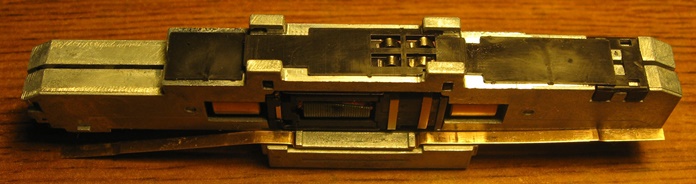
The speaker seats inside of a plastic shroud that mounts inside of a rectangular cutout in the bottom of the chassis. Metal tabs on the speaker butt up against the speaker current contacts that run down from the top of the motor saddle -
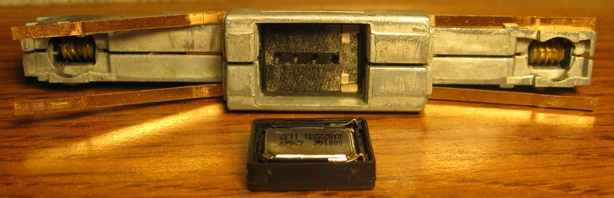
Unlike the SD40-2, superfluous speaker holes are not provided in the plastic fuel tank detail (superfluous because sound is actually designed to project upwards through the locomotive). All twelve wheels provide pickup (via low-friction axle cup wipers that contact long bendy metal contacts attached to the chassis). All six axles are geared and all gearing is plastic. Wheels are blackened and low-profile (no problems on Atlas C55 rails). There are no traction tires. MTL-style couplers are mounted to the shell.

The shell is all plastic with a modest number of separately applied detail parts. The fans for the dynamic brake blister are see-through metal, whereas the rest of the fans are not.

This second edition is such a disaster it's hard to know where to even start chronicling its various faults. First off, these models have very iffy pickup as delivered. Yes, once one gets going it usually stays going (as long as you don't try creeping it too slow). However, slow speed creep is extremely unreliable, as is stopping and reversing direction. IE, time to call out the five-finger rescue team. Now, there seem to be various reasons for all of this. First off, the chassis contact strips have a tendancy to lose contact with the sticky-uppy ears on the axle wipers and may require a bit of judicious bending to achieve a more optimal angle of contact. Secondly, the axle wipers themselves are slathered in wheel-blackening crud, including the dimples wherein the pointed ends of the axles seat. So, disassembling the trucks in order to clear all that out is almost certainly going to be needed -
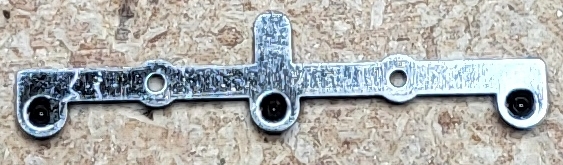
Even more insidious is the fact that the axles on the wheels (seemingly different from the ones used on the SD40-2) do not appear to extend all the way into the dimples on the axle wipers (not as delivered anyway). So, pickup just kind of randomly comes and goes depending on what the axle tips are doing at any given moment. What worked for me here was to widen the gauge of each wheelset (IE, pry the wheels a little further out from the plastic axle sleeves). And I mean widen them to the point that they are barely still in gauge (and maybe even a little bit out of gauge) in order to push them deeper into the dimples. This worked out really well for me as it did eliminiate virtually all of the pickup issues. But that said, they still remain finickier than most locos when it comes to needing spotlessly clean track.
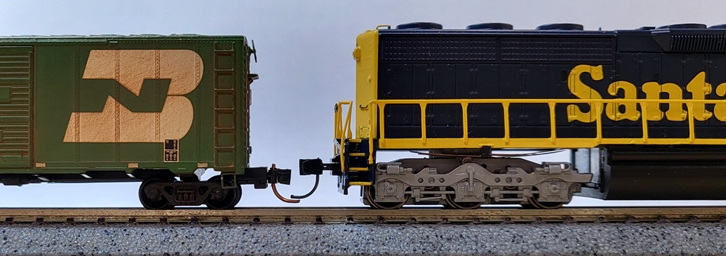
So, although annyoing in the extreme, the pickup issues are at least addressable. But the other major issue with performance (poor shell fit) is not. As you can see in the picture below, the SD45-2 shell does not fully seat onto the recycled SD40-2 chassis, and with the end result being a coupler that sits too high and will not reliably stay coupled to anything!
Another annoyance is this plastic crossmember on the trucks that will fall off if you just look at it wrong (oh, and the same can be said for the cab sunshades).
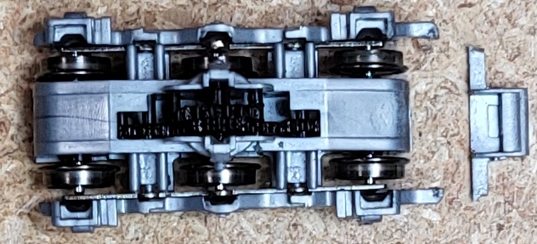
Lastly (and most embarassingly) is the ridiculously warped pilot. This is a glaring manufacturing defect that should've resulted in the entire shipment being sent back to China for replacement the minute it hit the US!
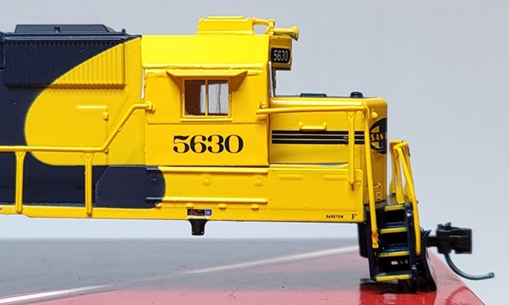
So, yeah, add it all up and what we have here is one of the absolute worst new N scale locomotive releases ever. I cannot for the life of me understand how these garbage models ever even made it to the shelves!
Shell removal on either version is blessedly simple - just take hold of the fuel tank with one hand and the shell with the other. Then, just sort of wiggle the shell up and off.
Grades: A (for the original design) and F (for the revised DCC-Sound version)