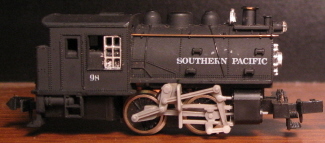
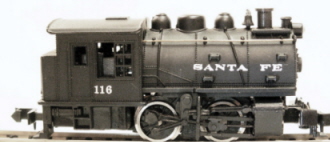
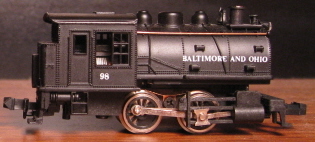
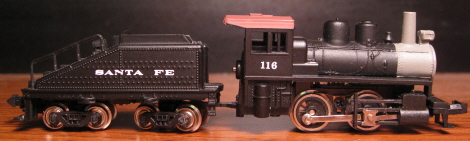
Introduced: 1970 (0-4-0 Docksider), 1978 (revised Docksider), 1985 (PRR Shifter with tender, and re-revised Docksider) and 2005 ("Percy")
As is Bachmann's wont, these 0-4-0's come in various flavors. The first release (1970) was an 0-4-0 "Docksider" tank switcher (IE, no tender). This first version is easily identified by its scary array of gray plastic running gear (I've also seen this version with black plastic running gear; not sure what the story is there). Circa 1978, a revised Docksider was released with a new mechanism/motor and slightly simplified black plastic running gear. Circa 1985, Bachmann once again replaced the mechanism in their 0-4-0 Docksider with an entirely new one (featuring a much-simplified array of metal running gear). Simultaneously, they also released a new "PRR Shifter" 0-4-0. This model incorporated the new Docksider mechanism, a new locomotive shell, and the slopeback tender from Bachmann's 1980 USRA 0-6-0 switcher. Bachmann ultimately discontinued both 0-4-0 models circa 2003.
There is also an earlier version of the Bachmann 0-4-0 w/tender floating around out there (a "B&O C16"). These used the same slopeback tender as the PRR shifter, the early "gray plastic running gear" docksider mechanism, and an all-new locomotive shell. I'm told that these were only available for a couple of years in the early 1970s... and only in Japan... and only as part of a complete trainset. The label on the trainset box incorrectly identifies the locomotive as being a "USRA 0-4-0". Obviously these are quite rare (at least in the US).
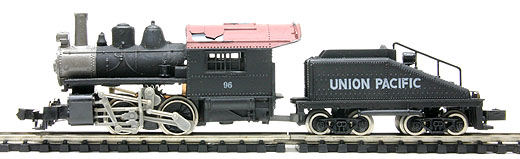
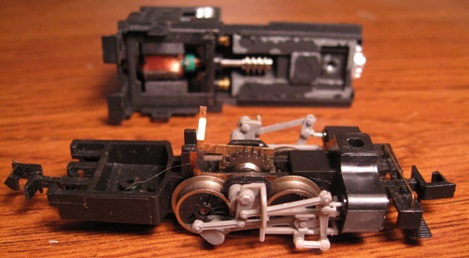
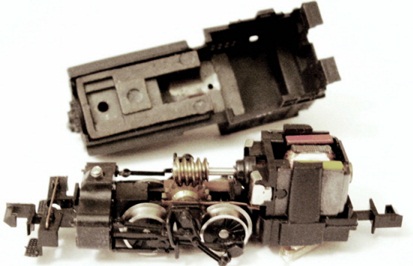
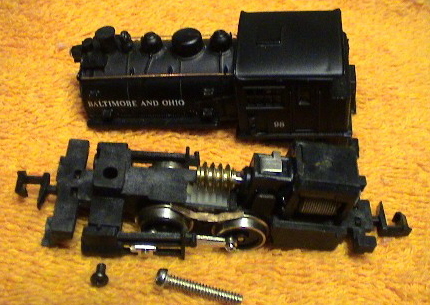
All versions of the mechanism are pretty simple - basically a 3-pole motor, a worm gear on a driveshaft, a main gear, and then gears on each of the axles. All four drivers provide pickup via relatively primitive wheel wipers. There are no traction tires. Rapido-style couplers are mounted to either end of the chassis. No lighting. The newer version comes with smaller wheel flanges, and as such can actually navigate Code-55 track (the same cannot be said for the earlier versions).
Regardless of the version, none of these models are particularly good runners. Given the miniscule pickup footprint, the lack of traction tires, and the overall light weight, basically what we have here are locomotives that can highball around a circle of track fairly well - and that's about it. Stalls at slower speeds are common, and you can pretty much forget about getting one of these things through a turnout (not unless it has powered frogs, anyway). Of all of them, I guess I'd rate the "PRR Shifter" version the best. In fact, if the tender provided anything in the way of pickup it might actually be a runner. As for the docksider, I think the main problem (well, in addition to all of the aforementioned problems) is that the shell is totally oversized for the chassis. It seems simultaneously top-heavy and end-heavy - the end-result being a very wobbly and unstable ride (and thus a tendancy to derail at a moment's notice). Conversely, the shifter shell seems to be much more suited to the chassis, definitely making it the smoothest running unit of the bunch.
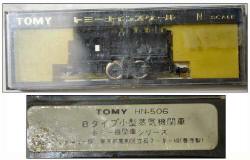
Trivia - These same models were also distributed by Tomy in the 1970s (probably only in Japan). Same basic packaging, but with the Tomy name added. EG -
As noted above, Bachmann also released a "Percy" 0-4-0 in 2005 as part of their "Thomas & Friends" product line -

Now, I don't normally delve into European-style models, but I've received a number of inquiries about this one, so here it is. Note that the fancy coreless motor receives its current from a PC board, so one could (in theory) wire up a decoder in there someplace -


I don't know if the above pictured mechanism traces its origins all the way back to the original 2005 release, but that's what things look like at least as of this 2025 writing. And unfortunately, performance is about as bad as on those older docksider models (if not worse). The one I tested had a bad case of the shakes and wobbles (resulting in derailments if given enough throttle). And once again, pickup is just terrible, with mine constantly stalling out through turnouts (even turnouts with electrified frogs). So, sorry kids, no es bueno 
Shell Removal -
Disassembly is pretty simple. Remove the two screws from the bottom (or in the case of the first two versions, the one screw), and then unclip the two plastic clips from the back. At this point the shell should pop right off. The motor/driveshaft/worm on the oldest version is held inside the shell by the smokestack (which functions as a screw). Unscrewing the smokestack will allow you to pull all that stuff out of there.
Grade: C for the newest version (D for the earlier plastic-running-gear versions)
Reviewed: 3/71 Model Railroader ("The ready-to-run N scale model follows prototype dimensions and proportions well. A few liberties have been taken to accommodate the motor and drive. Thus the cab is a little longer than scale. The drivers scale 56" in diameter. (The prototype had 48" diameter.) The larger size permits use of a larger drive gear. The body is a one-piece plastic casting with good detail. All fittings except brass wire horizontal handrails are cast on. The 3-pole motor completely fills the cab; a cast zinc ballast fills the rest of the superstructure. The frame, cover plate, and cylinders are plastic castings. The wheels have metal rims and plastic centers. The wheel flanges are .031" deep and the check gauge is .31". The rods and valve gear are also plastic castings. Wipers running on the inside of the driver rims use all four wheels foe electrical pickup. The worm and worm gear are brass. The worm gear is actually an idler engaging smaller drive gears on each axle... The 1.5 ounce model, painted and lettered, is available in two road names: B&O and SP. Our test sample ran quite smoothly and at reasonable scale speeds when coupled to a string of cars. Running light it had a high starting speed... We were able to pull 10 average freight cars on straight level track. Our sample tended to have poor contact, no doubt due to having only four wheels and rather light weight... To have such a small locomotive available in N scale is a boon to the hobby. Price: $9.98")