
Introduced: 2003 (Korean-made version), 2007 (Chinese-made version) and 2026 (DCC-Sound version)
For reasons unknown, Atlas originally opted to farm this locomotive out to Ajin (Korea) rather than use their normal Chinese manufacturing sources. Ajin was best known for the brass locomotives they made for Overland, not to mention all of the good-not-great models they made for Model Power (most notably MP's line of N scale steam). Unfortunately, this Ajin mechanism isn't quite up to Atlas's normally high standards. Yes, it's a respectable runner in most respects - good pickup, smooth throttle response, nice slow speed creep, decent pulling power, etc. However, it's a bit noisier than a typical Atlas diesel (and with some of them being noisier than others). I'm not sure if the problem lies in the design or the manufacture, but something in there just ain't meshing together quite right and the end result is a definite coffee-grinder buzz as it rolls along. The problem is particularly noticeable at the high end of the throttle (although in all fairness, one probably wouldn't ever need to run a yard switcher that fast).
More annoying to me is the fact that Ajin didn't go ahead and and actually finish putting the damned thing together at the factory. Nope, they instead decided to take the day off and stick three sets of handrails in the box, ala carte, for us poor modelers to install ourselves (I guess to remind all of us lazy "service industry" Americans just what it's like to work in an Asian manufacturing plant). Seriously, not since the Kato Mike have I come across such a nightmarishly diabolical set of locomotive add-on parts. "Plug this molecule-sized handrail pin into this atom-sized hole" doesn't even begin to cover it.
So, in 2006 (after three runs) Atlas apparently decided they'd had enough of Ajin and relocated production to China. The mechanism was completely redesigned and a new version was released in 2007. And suffice it to say, this new model is every bit a typical Atlas diesel - IE, smooth, quiet, gorgeous and perfect. Better still, all of the handrails come preinstalled.
Korea on the left (with factory decoder), China on the right -
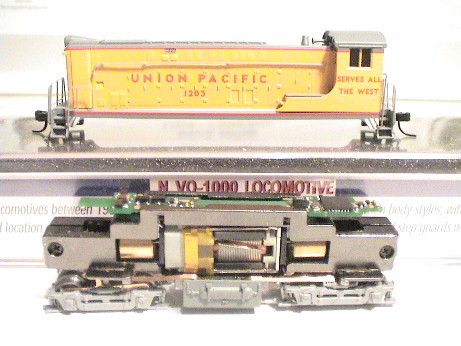
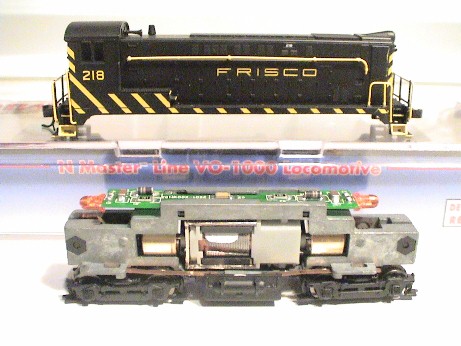
Despite the different performance characteristics, both early versions sport all the features one normally associates with "modern" Atlas diesels - IE, split-frame / DCC-Ready / all-metal chassis, 5-pole / skew-wound "scale speed" motor with dual flywheels, low-friction drive, bi-directional "white" LED lighting, all-wheel drive and pickup (no traction tires), blackened / low-profile wheels, shell-mounted Accumate couplers, all-plastic gearing, etc.
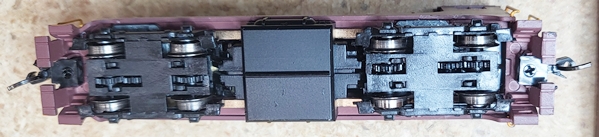
Identifying different versions is pretty simple - just look at the box and see what it says vis'a'vis the country of origin. No box? Well, pull the shell. Ajin frames are cast from a very strange shiny black metal, whereas the Chinese-made ones are cast using the more familiar flat gray/silver metal.
Shells are not interchangable between the two versions without modification (Atlas has a .pdf document on their website that will walk you through the steps necessary to make said swap). Oddly enough, neither version supports conversion to "Rapido" style couplers (my apologies to the three guys out there disappointed by that).
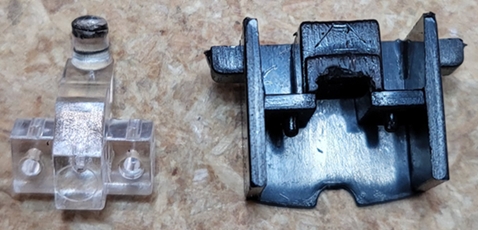
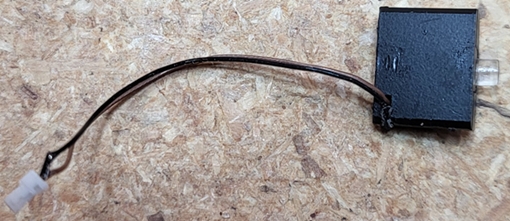
As noted above, Atlas released all-new VO-1000 models in 2026. These were available either DCC-Ready or with factory-installed ESU LokSound decoders. The internals were redesigned along the lines of the 2024 Atlas Trainmaster re-release. IE, rather than using the old split-frame chassis to transfer current to the motherboard, the chassis is now essentially one big hunk of metal with wires from the trucks transferring current directly to the board. Additional wires from the board transfer current to the motor contacts. An LED mounted to the back of the motherboard provides light for the hood headlight. A wiring harness plugged into the motherboard provides current for a light box mounted inside the cab (which lights up the cab headlight). The drivetrain components drop inside of the chassis and a separate metal lid screwed to the top holds everything in place. The motherboard is screwed to the top of the chassis lid and comes with a preinstalled speaker on all models. The DCC interface on the motherboard (designed by ESU) is designated as "E24".

The shell, fuel tank and trucks all appear to be the same as on the previous version, so the shells do indeed swap (I tried it myself).
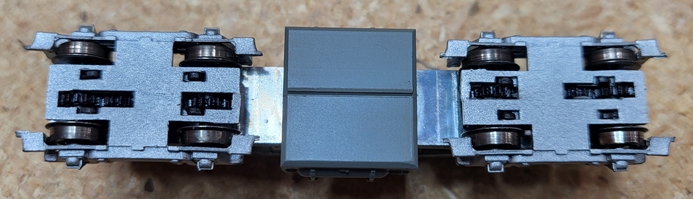
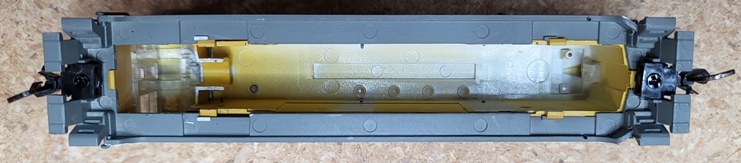
As mentioned above, lighting for the cab headlight was completely redesigned. So, when swapping shells you'll need to keep the cab lighting elements with their original chasses and not with their original shells -
Performance on this new version is outstanding in every way and every bit the equal of the previous version - smooth and quiet, nimble throttle response, solid pulling power (20-some assorted freight cars through curves on level track), no problems on sharp (9.75" radius) curves, no problems on code 55 rails, etc. OK, out of the box mine did have a tendancy to stall at slow speeds. However, I was able to address that issue by simply cleaning the wheels and track (and then keeping them clean).
The sound on the DCC-Sound versions is decent enough (basically about what one would expect from a small N scale locomotive). I didn't notice any difference in performance when operating mine with an analog powerpack (IE, they run equally well using DCC or DC control). As seems to be typical with DCC-Sound models these days, the decoders in these locos are programmed to go through a rather protracted sequence of "start up" shenanigans before they start moving. To eliminate this nonsense (if you're so inclined), simply set CV124 to 0. Also note that the default behavior is for the sound to be off (IE, put the loco on the rails and it won't make a peep). To turn sound on, hit F8.
Prototype -
Built by Baldwin in the 1940's, the VO-1000 diesel locomotives could be found in both yard and mainline service across the country. Atlas' version, recreated for the first time ever in N scale (in plastic), is a true replica of the handsome engine.
Features (2026 version) -
- Prototypical decoration, stack configurations and step guards per railroad / era
- Directional lighting
- Blackened wheels
- Atlas Silver version is Sound Ready and equipped with speaker for easy conversion to DCC sound
- E24 DCC Plug
- Gold version Supports all DCC-programming modes; DCC includes RailCom and RailComPlus, with 14, 28 or 128 speed steps and with 2-digit and 4-digit addressing
- Flexible mapping of function keys F0 to F28
- A total of 6 DCC function outputs are available, and all can be function mapped (disable, brightness, light effects) individually
- Follows all NMRA DCC standards and recommended practices
- Over 20 sound effects are available, including engine start-up and shutdown, prime mover sounds through all eight notches, bell, air horn, air compressor, dynamic brakes and more
- There are up to 16 user-selectable horns, 2 user-selectable bells, and 2 user-selectable synchronized brake squeals
- Equipped with ESU's Exclusive "Full Throttle" features for ultimate realism in prototype running
- AccuMate couplers
Shell Removal -
Basically just use small screwdrivers or toothpicks to pry the shell indentations away from the chassis bumps and the shell should come up and off fairly readily. Note that the fuel tank is comprised of two halves and comes off by separating the two right down the middle (that took me a while to figure out).
Grade: A (for all, although maybe an A- for the original Ajin version)
Ajin version reviewed: 07/03 Model Railroader ("An excellent prewar Baldwin VO1000 diesel switcher with railroad-specific detailing has been released by Atlas. Each of these models has the appropriate details and exhaust stack configration that matches its paint scheme... The Atlas models closely follow prototype drawings... Our sample VO1000 followed the familiar design Atlas has used in its recent N scale locomotives... The switchers come assembled except for the addition of the end and corner railings... The mechanism follows the popular N scale split-chassis design... Our samples started and ran smoothly at speeds under 9 volts... The drawbar pull is equivalent to about a dozen cars... Accumate magnetic couplers are factory-installed at the proper height... All of the wheelsets on our samples matched NMRA standards... Our sample VO1000s were smoothly painted with sharp stripes and lettering. These early diesel switchers fit perfectly on model railroads set in the 1940s and later. Operation-oriented modelers will really enjoy running the VO1000s as they have the best slow speed performance I've ever seen in an N scale switcher. ATSF, ACL, LV, SP, CBQ, GN, MR, NYC, Undec. $104.95 ($139.95 with decoder)")