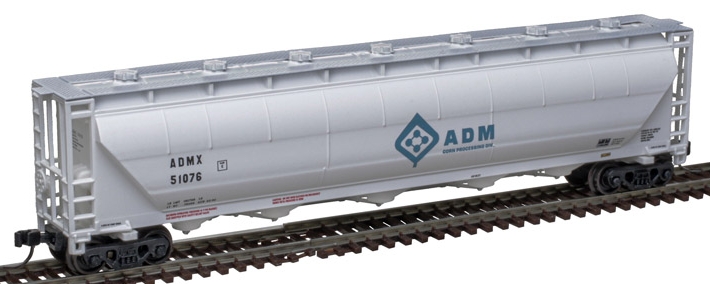
These models were released by Walthers circa 1997. In 2018, Atlas acquired the tooling for this car (among others) and went on to reissue them as part of their "Master" line in 2025. Updates included all-new end cage tooling and etched metal roofwalks.
Here's what Atlas has to say about them -
The Pressure Differential, or "PD" covered hopper was designed as a competitor to the General American Transportation Airslide hopper in the early 1970s to transport light, powdered materials. Unlike the Airslide, which forced pressurized air up through a fabric liner to help fluidize the cargo, the PS series of hoppers applied both a positive pressure of about 15 lbs. psi above the outlets as well as a vacuum at the outlet to help draw the cargo from the car. This design was well suited to products with very small particle size, such as talc, clay, plaster, and cement which would readily foul the fabric liner in an Airslide design. In addition, since the upper hatches did not need to be opened during unloading, the PD hopper was also ideal for transporting goods where contamination by outside air, dirt, or moisture could affect the load. The Atlas 5-bay PD5000 hopper is based on the original North American Car Company (NACC) design for a 5150 cu ft PD covered hopper, which was later manufactured as a 5125 cu ft model by Trinity Industries. These cars were mostly provided as lease cars, and as such, carried many colorful schemes and product logos during their lifetimes, however several major railroads such as Norfolk Southern purchased fleets as well.
Here's what Walthers had to say about them -
As covered hoppers evolved in the 1960s, larger cylindrical and rounded car bodies were introduced. This shape allowed more material to be carried and used gravity to force the load toward the bottom discharge outlets. Some of these designs also used pneumatic unloading systems. The continued demand for larger cars led Trinity Industries to introduce their new Power-Flo pressure differential (PD) hoppers in 1987. The design utilized proven technology by combining a pressurized system with rounded side walls. This allowed for increased payload, and reduced the time needed for loading and unloading.
